Bending Light Back to Life: Inside the Workshops Where Dead Neon Signs Get a Second Glow
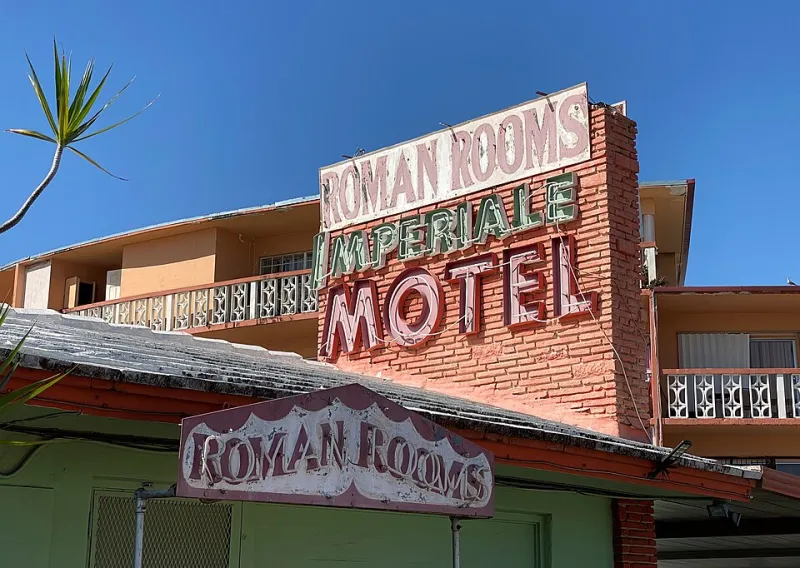
Photo: Phillip Pessar, CC BY 2.0, via Wikimedia Commons
The first thing you notice in Ray Delgado's workshop off Route 66 in Flagstaff isn't the glow. It's the smell—warm glass, argon, and the faint ozone tang of a transformer testing a tube that hasn't lit up since 1974. Delgado runs one of the few full-service neon restoration shops left in the Four Corners region, and his back room looks like the lobby of a ghost hotel: a partially restored arrow sign from a demolished Barstow motel, a feathered cactus from an old Albuquerque diner, and a bull rider, missing one arm, that once lured travelers off the highway in Tucumcari.
The Wrecking Ball Is the Deadline
Every saved sign has a rescue story, and most of them end the same way: someone with a pickup truck showing up the morning before the bulldozers. Delgado got his start that way, pulling a rusted "VACANCY" sign out of a Las Vegas demolition pile in 2011. Today, the network of collectors who do this work across Arizona, New Mexico, Nevada, and West Texas is small, informal, and constantly racing developers who see a vintage sign as scrap metal and a liability.
"The signs aren't worth anything until somebody saves them," Delgado says. "Then suddenly everyone wants one."
That paradox defines the economics of the whole scene. A rescued sign might cost a few hundred dollars in salvage fees and a weekend of labor to haul home. Restoring it—rebending broken glass, replacing transformers, repainting the can—can run anywhere from $2,000 for a small border tube to $30,000 or more for a big rooftop piece. And the market? Restored mid-century signs have appreciated hard in the last decade, with prime casino and motel pieces fetching five figures from collectors, restaurants, and museums. But the people doing the saving rarely see that money. They're in it for other reasons.
Glass Is a Hand Skill
Restoration starts at the torch. Neon tubes are bent by hand over patterns—full-size drawings of the letterforms—using a ribbon burner that softens the glass just enough to shape without kinking. It's a skill that nearly vanished when LED took over the sign industry in the 2000s. The practitioners left are largely self-taught or trained by the last generation of commercial benders, and they're getting older.
Delgado learned from a retired bender in Albuquerque who "charged me in tamales and patience." Now he teaches weekend workshops, and the students are younger than you'd expect—tattoo artists, glassblowers, a couple of art school grads who got tired of screens. The revival of neon as an art material, driven partly by Instagram's endless appetite for glowing interiors, has created just enough demand to keep the craft alive.
But restoration is different from making new art pieces. A 1950s motel sign has to look right. That means matching the era's glass colors, which don't exist anymore in standard catalogs, and sometimes sourcing vintage transformers on eBay from sellers in Ohio and New Jersey. Purists argue about whether a sign with modern LED guts inside old glass counts as restored or faked. Delgado falls somewhere in the middle: "If the letterforms are original and the glow reads right at 60 miles an hour, it did its job."
Where Do Saved Signs Go?
Some end up in backyards. Some end up in restaurants and breweries that want instant Americana. A surprising number end up in museums—the Neon Museum in Las Vegas has become the region's most visible sign sanctuary, and the historic sign programs in Albuquerque and along Route 66 have given rescued pieces a second life mounted on public streets.
The backyard collectors are the ones with the strongest opinions. Skip Holcomb, a retired electrician in Kingman, has 23 signs on his property, most of them lit every night. Neighbors, he says, mostly love it. "One guy complained the glow kept him up. I pointed out he moved next door to a neon collector."
Can the Glow Survive?
The math is brutal. More mid-century motels and diners come down every year, and there aren't enough benders, workshops, or storage units to catch everything. What keeps the scene going is stubbornness and a shared belief that a region's identity lives in its roadside light—that the Southwest without vintage neon is just another sprawl of beige stucco.
Delgado puts it simpler. "Every sign we lose is a story nobody can tell anymore. The glass is the last witness. Somebody's got to keep it lit."