When the Machine Pulls Cards: AI Tarot Is Here and Southwest Readers Are Not Having It

Somewhere between a Mercury retrograde meme and a TikTok algorithm, tarot got complicated. Not the ancient, smoke-and-candlelight kind of complicated — the silicon-chip, language-model, your-phone-knows-your-future kind of complicated. AI tarot bots have arrived, they're multiplying fast, and if you spend any time in the spiritual communities scattered across the Southwest, you already know the temperature in the room has dropped a few degrees.
Apps like Layla, Mystic AI, and a dozen half-built competitors are now offering full card spreads, personalized interpretations, and daily readings — all generated in seconds, all available at 2 a.m. when your anxiety peaks and your human reader is asleep. The pitch is obvious: accessible, affordable, always on. The problem, according to a lot of people who've built their lives around this practice, is that the pitch is also kind of hollow.
What the Bots Actually Do
To be fair, some of these tools are genuinely impressive on the surface. Feed a well-trained language model the right prompts, and it can spit out a three-card spread interpretation that sounds thoughtful, uses the right symbolic vocabulary, and even asks reflective follow-up questions. For someone who's never sat across from a reader, it might feel revelatory.
The apps lean hard into aesthetics — dark interfaces, animated card flips, moody desert-sunset color palettes that feel suspiciously like they were designed to appeal to exactly the demographic that's been growing the tarot market for the last decade. Some even claim to "learn" your patterns over time, building a profile of your questions and concerns the way a therapist might build a case history.
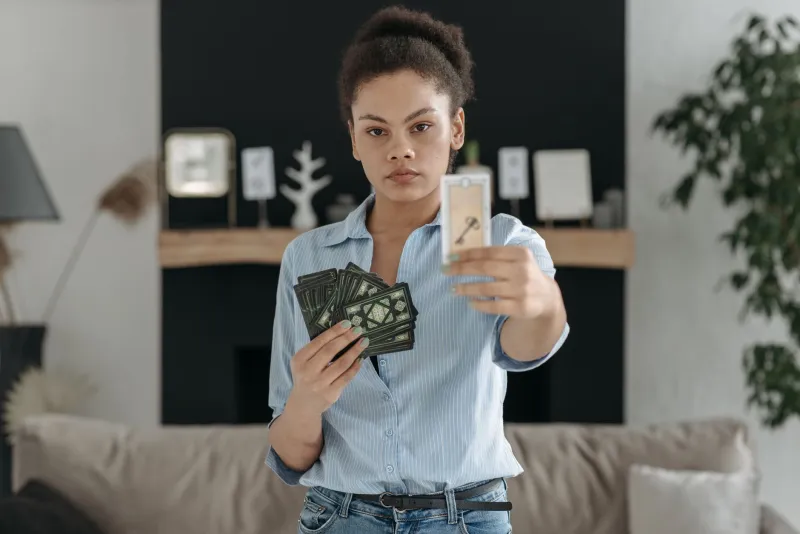
But here's where it gets thorny: tarot has never really been about the cards. Ask any serious practitioner and they'll tell you the deck is a mirror, not a map. What makes a reading land isn't the accuracy of the symbolism — it's the presence of another human being who's actually paying attention to you.
The Southwest Readers Pushing Back
In Phoenix, a reader who goes by Soledad Vega and has been practicing for eleven years describes her first encounter with an AI tarot bot as "genuinely unsettling." Not because the output was terrible — it wasn't — but because it was good enough to fool someone who didn't know better.
"It hit all the talking points," she says. "The Tower means upheaval, the Ace of Cups means emotional new beginnings — fine, technically correct. But there was no intuition behind it. It wasn't reading me. It was reading a prompt."
Vega's frustration isn't unique. Across Tucson, Santa Fe, and Las Vegas, readers are watching their social media feeds fill up with AI-generated content that mimics the visual and linguistic style of real spiritual practice. Some bots are even posting "readings" as short-form video, using AI voiceovers and stock footage of desert landscapes to create content that looks, at first scroll, indistinguishable from a human practitioner's work.
The economic anxiety is real and specific. Tarot readers in the Southwest have spent years building audiences — through farmers markets, metaphysical fairs, word of mouth, and hard-won social media presence. Many of them are self-employed, operating on tight margins. When an app offers unlimited readings for $9.99 a month, the competition isn't abstract.
"I charge $80 for an hour," says a Albuquerque-based reader who asked to be identified only as Marco. "An app charges $10 a month and you can ask it questions all day. I'm not going to pretend that's not a real threat."
The Users Who Don't See the Problem
Not everyone in the conversation is a practitioner, though, and the people actually using these apps have a different set of concerns — or a different absence of them.
Talk to regular users and a pattern emerges: most of them aren't replacing human readers. They're using AI tarot as a journaling prompt, a daily check-in, a low-stakes way to process whatever's happening in their lives. Several users described the experience as less about divination and more about having a structured way to think out loud.
"I know it's not magic," says a 28-year-old graphic designer in Scottsdale who uses two different tarot apps daily. "But it asks me questions I wouldn't ask myself. That's worth something."
This is the part that makes the conversation genuinely complicated. If the tool helps people reflect, slow down, and engage with their inner lives — even without a human on the other end — is that actually a bad thing? The Southwest's spiritual community has always prided itself on accessibility, on creating spaces for people who felt excluded from more rigid religious traditions. Does gatekeeping AI tarot undercut that same spirit?
Authenticity in the Age of the Algorithm
The deeper argument isn't really about apps or revenue. It's about what tarot is and what it's supposed to do.
For practitioners like Vega, the reading is a relational act. It requires someone to hold uncertainty, read body language, adjust in real time, and sometimes say the thing the client doesn't want to hear. That's not a skill set you can fine-tune through machine learning — at least not yet, and maybe not ever.
"An AI can tell you what the Five of Pentacles traditionally means," she says. "It cannot tell you that you flinched when I laid it down, or that your voice changed when you talked about your job. That's where the actual work happens."
But the counterpoint is equally honest: not everyone has access to a skilled reader. Not everyone can afford $80 an hour. Not everyone lives in a city with a thriving metaphysical community. For someone in a rural stretch of New Mexico or a suburb without a single occult shop in a thirty-mile radius, an AI tarot bot might be the only entry point they have.
What Comes Next
The Southwest's spiritual community isn't monolithic, and the responses to AI tarot reflect that. Some readers are experimenting — using AI tools in their own practice as a starting point before layering in their intuition. Others are doubling down on the human element, marketing their work explicitly as something the algorithm cannot replicate.
A few are doing something more interesting: building community around the distinction. Hosting workshops on the difference between AI interpretation and intuitive reading. Creating content that walks people through what a real session actually involves. Using the bot boom as an unexpected teaching moment.
None of this is going to stop the apps from spreading. The market logic is too clean, the convenience too real, the barrier to entry too low. What it might do is sharpen the conversation about what people are actually looking for when they sit down with a deck of cards — and whether that thing can ever be replicated by a system that's never felt lost, never sat with grief, never watched the sun set over the Sonoran and wondered what any of it means.
The neon is bright out here. But some lights run on something the grid can't supply.