Cards, Cosmos, and Concrete: The Southwest's Underground Mystics Are Building a New Kind of Church
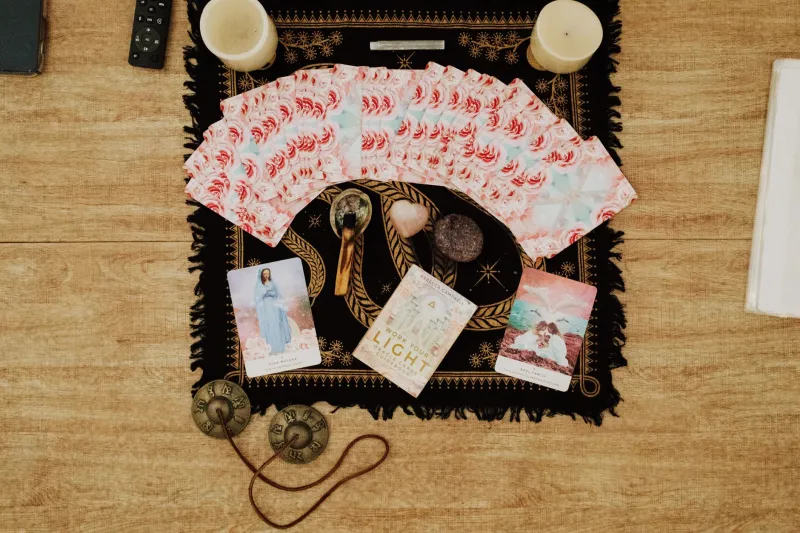
The folding tables are set up by seven. Candles in mismatched holders line the perimeter of a converted carport in central Phoenix, casting long shadows across hand-painted oracle cards and printed birth charts. About twenty people are crowded onto lawn chairs and floor cushions, most of them strangers an hour ago. By the time the night ends, some of them will be crying. A few will call it the most honest conversation they've had in years.
This is not a church. Nobody here has a theology degree. The woman running the show learned astrology from YouTube tutorials and library books, and she'll tell you that freely. But if you ask the people sitting in that carport whether what's happening feels real, the answer is pretty unanimous.
"People are hungry for something that doesn't talk down to them," says the organizer, who goes by Solène and has been hosting these gatherings for about three years. "Institutions give you answers. We ask questions."
Across the Southwest—Phoenix, Tucson, Albuquerque, El Paso, Las Vegas, and a dozen smaller desert towns in between—a loose, leaderless movement of DIY spiritual practitioners is quietly reshaping how people think about healing, community, and meaning. They're astrologers who learned from Reddit threads. Tarot readers who built their own decks in Procreate. Energy workers who mix Reiki with curandera traditions and don't feel the need to explain themselves to anyone. They operate out of garages, living rooms, rented event spaces, and the comments sections of Instagram posts that somehow rack up thousands of replies.
And they're very much done waiting for mainstream validation.
The Punk Rock of Spiritual Practice
There's a reason this wave feels different from the wellness industry's version of mysticism—the kind that lives in $90 crystal sets and influencer retreats in Sedona. The practitioners driving this movement are, by and large, working-class people who grew up in the desert and found that traditional religion didn't fit and therapy cost too much. They built something else.
Marco, a tattoo artist in Albuquerque who moonlights as an astrologer, puts it bluntly: "The wellness world is expensive and white and kind of exhausting. What we're doing is more like a punk show in somebody's basement. You show up, you're welcome, it's five bucks or free, and nobody's selling you anything."
That ethos runs deep. Many of these practitioners actively resist monetizing their work beyond the basics, or they operate on sliding scales. Oracle decks are printed in small runs at local copy shops and sold at cost. Birth chart readings happen over tacos. Moon circles get announced via group texts and flyers stapled to telephone poles.
The DIY aesthetic isn't accidental. It's ideological. These communities have watched the wellness industry commodify everything from sage bundles to Indigenous ceremony, and they're deliberately building something harder to sell.
Desert Mysticism Has Always Been Here
It would be a mistake to treat this as something entirely new. The Southwest has always been a landscape that bends toward the mystical—ancient astronomical alignments at Chaco Canyon, the deep spiritual traditions of Pueblo and Diné peoples, the Catholic folk mysticism of New Mexico's penitente villages, the UFO culture of the Chihuahuan desert. The region has a long memory for the idea that the sky means something.
What's changed is the medium and the mix. Today's desert mystics are synthesizing all of it—astrology, tarot, ancestral healing, astral projection, somatic work—and broadcasting it through social media in real time. A reader in Tucson can build a following of 40,000 people while still hosting twenty-person ceremonies in her backyard. The scale is new. The impulse isn't.
Lorena, who publishes an independent oracle deck drawing on Chicanx iconography and Mesoamerican cosmology, describes her practice as a form of cultural reclamation. "My grandmother read cards. Her grandmother read cards. Somewhere along the way we were told that was superstition, that it was backwards. I'm just picking it back up."
Her deck, printed in a run of 500 and sold out twice, has a waiting list. She's currently working on a second edition and has no plans to pitch it to a major publisher.
The Social Media Altar
If the carport is where the community breathes, Instagram and TikTok are where it grows. The Southwest's underground mystics have figured out something that a lot of traditional institutions haven't: people want to be seen, not just taught.
The content that lands isn't polished or produced. It's someone sitting in their car in a Walmart parking lot doing a mercury retrograde breakdown. It's a birth chart reading filmed on a phone propped against a stack of books. It's a tarot pull done in ten minutes before a shift at a restaurant, posted with a caption that somehow nails exactly what 15,000 people are feeling that week.
"I don't have a ring light. I don't have a script," says Dex, an astrologer based in Las Vegas who built a following of nearly 60,000 largely by accident. "I just talk like I'm talking to my friends. Apparently that's a thing people want."
What Dex and practitioners like them have figured out is that authenticity is the product. In a landscape saturated with curated wellness content, the messy, specific, geographically rooted voice of a desert kid talking about Saturn returns over a backdrop of strip mall neon hits differently.
What Community Actually Looks Like
The ceremonies themselves vary wildly. Some are structured—guided meditations, group chart readings, intention-setting rituals tied to lunar cycles. Others are looser, more like potlucks where the conversation happens to be about past lives and grief and what it means to be alive in a place that feels like it's always on the edge of something.
What they share is a commitment to showing up in person. For all the social media reach, every practitioner interviewed for this piece emphasized the same thing: the real work happens in the room.
"You can watch a thousand tarot videos," Solène says, straightening a card on her table. "But sitting across from someone and having them look you in the eye while they talk about your life—that's different. That's what people are coming for."
The communities forming around these practices are genuinely diverse in ways that a lot of spiritual spaces aren't—racially, economically, in terms of age and background. People who'd never set foot in a yoga studio are showing up to moon circles. Veterans. Mechanics. High school teachers. The desert, it turns out, is a pretty good equalizer.
No Permission Required
None of this has a headquarters. There's no governing body, no certification that matters, no single voice speaking for the movement. That's either its greatest strength or its greatest vulnerability, depending on who you ask.
But for now, the carport is full, the candles are burning, and twenty people who didn't know each other this morning are talking about things they've never said out loud. Nobody's waiting for an institution to tell them this is legitimate.
Out here in the desert, under skies that have always been read as maps, that feels about right.