The Algorithm Reads Your Stars: How Desert Spiritual Practitioners Are Wiring Ancient Wisdom Into the Digital Age
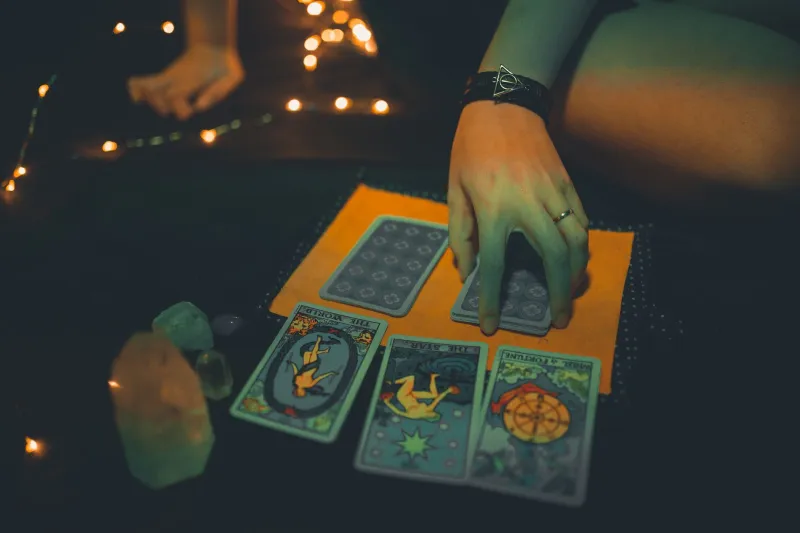
Somewhere between Albuquerque and the open sky, a tarot reader named Soledad is pulling cards for a client she's never physically met — a woman in Portland who found her through Instagram Reels and booked a session via a Calendly link. The reading happens over Zoom. The deck is hand-painted. The algorithm, in its strange and indifferent way, made the whole thing possible.
This is the new shape of spiritual practice in the Southwest. Ancient tools, desert roots, and a broadband connection doing the heavy lifting.
Screens in the Sanctuary
For decades, practitioners of tarot, astrology, energy healing, and other metaphysical arts operated in a particular kind of ecosystem — word of mouth, community centers, New Age shops tucked between a nail salon and a tax preparer. The desert cities of Arizona, New Mexico, Nevada, and Southern California had their own established networks, informal hierarchies, and gatekeepers. You found your reader through a friend, or you didn't find them at all.
That model didn't disappear, but it's sharing space with something entirely different now.
Co-Star, the AI-powered astrology app, has logged over 35 million downloads. Pattern, The Pattern, Sanctuary — the app stores are lousy with platforms promising personalized cosmic insight generated in seconds. On TikTok, the #tarot hashtag has cleared 30 billion views. The sheer volume of people engaging with divination-adjacent content online has exploded, and Southwest practitioners are both riding that wave and wrestling with what it means.
"I had a client tell me she'd already run her birth chart through three different apps before she booked with me," says Marcus, an astrologer based in Tucson who has been practicing for nearly fifteen years. "She came in with all this data and almost none of the context. The apps gave her information. They didn't give her understanding."
That distinction — information versus understanding — comes up constantly when you talk to practitioners in this region about technology's role in their work.
What the Bots Can't Do
The AI-generated birth chart is, by now, a familiar artifact. Feed a platform your date, time, and place of birth and within seconds you'll receive a detailed breakdown of your sun, moon, and rising signs, your Venus placement, your north node, your Saturn return timeline. It reads as authoritative. It can also read as hollow.
"The chart is a map," says Yara, a Phoenix-based astrologer and energy healer who runs a popular Instagram account alongside her private practice. "But the territory is a human life. No algorithm knows that your dad left when you were nine, or that you've been in the same job for twelve years and you're dying inside. That context is everything."
Yara isn't anti-technology — she uses scheduling software, promotes her work on social media, and has even experimented with AI tools for drafting newsletter content. But she draws a hard line around the interpretive work itself. "I think of the apps as a front door," she says. "They get people curious. Then they come to me to actually walk through."
That framing — tech as an on-ramp rather than a destination — is common among the more experienced practitioners in the region. What varies is how comfortable people are with where the on-ramp leads.
Access Is the Argument
For a younger generation of practitioners and clients, the democratization argument carries serious weight. Traditional spiritual services have never been cheap. A one-hour reading with an established astrologer in a major city can run $150 to $300. Energy healing sessions, sound baths, and personalized ritual consultations can go higher. For communities where disposable income is limited — and across much of the rural Southwest, that's a significant portion of the population — those price points have always functioned as a kind of invisible velvet rope.
Digital tools, whatever their limitations, punch through that barrier.
"I grew up in a small town outside of El Paso," says Dani, a 26-year-old who started a free oracle card community on Discord after discovering tarot during the pandemic. "There was no one doing this work publicly where I was from. I learned everything from YouTube and Reddit. The community I built online is mostly people like me — people who didn't have access any other way."
Dani's Discord server now has over 1,400 members, many of them in their twenties and early thirties, scattered across the Southwest and beyond. They share card pulls, discuss interpretations, trade book recommendations, and occasionally argue about whether AI-generated readings are meaningful or just a novelty. The debates are lively. The community is real.
"Some of the older practitioners I've connected with online think what we're doing is shallow," Dani admits. "But I think they're confusing accessibility with cheapness. These people are serious. They just didn't have a teacher."
The Tradition Problem
Not everyone is comfortable with the pace of change. Among practitioners with deep roots in Indigenous, curandera, or other culturally specific healing traditions, the conversation around technology gets considerably more complicated.
Several practitioners in New Mexico and Arizona who were contacted for this article declined to comment on the record, citing concerns about cultural appropriation and the flattening of nuanced traditions into digestible digital content. The worry isn't just philosophical — it's practical. When an AI-generated platform pulls from a broad pool of metaphysical content without distinguishing between, say, Diné ceremonial knowledge and a 1970s New Age synthesis, something gets lost in the blending.
"There are things that are meant to be passed down in relationship," says one Santa Fe practitioner who asked not to be named. "When you strip out the relationship and just deliver the information, you've changed what the thing is. It might look the same. It isn't."
This tension — between expanding access and preserving the integrity of lineage-based practice — doesn't have a clean resolution. The technology isn't going anywhere, and neither are the traditions.
Neon and the Numinous
What's emerging across the Southwest is less a war between old and new than a complicated negotiation. Practitioners are building hybrid models: Instagram presences that funnel into in-person community circles, AI tools used for intake and prep work rather than the reading itself, online communities that eventually generate real-world meetups in Tucson parking lots and Albuquerque backyards.
The desert has always been a place where things that seem opposites end up sharing the same landscape. Heat and cold. Ancient stone and neon light. Silence and the howl of something you can't quite name.
Maybe the algorithm and the oracle card aren't as far apart as they look. Or maybe they are, and the practitioners navigating that gap are doing the most interesting spiritual work happening anywhere in the country right now.
Soledad, the tarot reader from Albuquerque, puts it simply: "The cards don't care how the client found me. They just care that the client showed up."
In the desert, that might be enough.