Sacred Shelves in the Sun: How the Southwest's Occult Bookshops Became the Community Centers Nobody Saw Coming
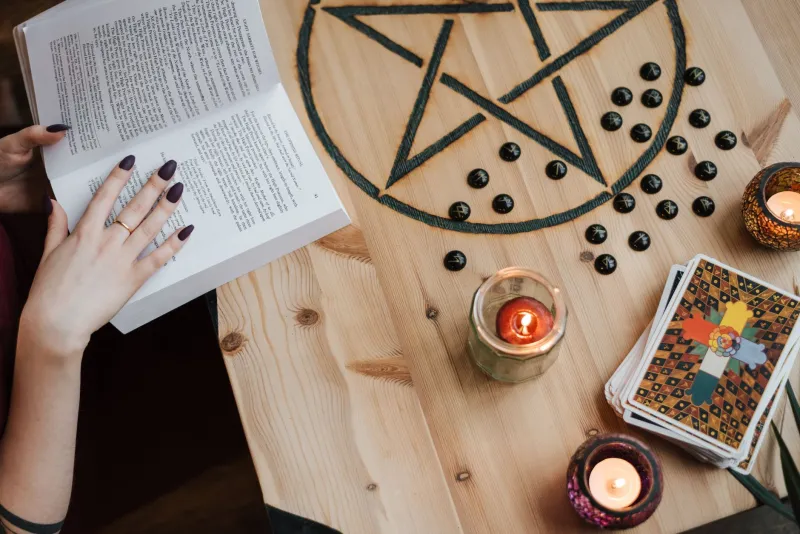
Walk into a certain kind of shop on a Thursday evening in Albuquerque and you might stumble into a heated debate about Gnostic cosmology. Or a tarot pull for someone going through a divorce. Or a teenager who just discovered Robert Anton Wilson sitting cross-legged on the floor, completely lost in a book they can't afford yet but the owner told them to read anyway.
This is not a church. It is not a therapy office. It is not a community center in any official sense. It's a bookstore — dusty, candlelit, slightly overwhelming — and it might be one of the most genuinely important cultural spaces operating in the Southwest right now.
Shelves as Infrastructure
The independent occult and metaphysical bookshop has always existed on the cultural margins. For decades, these stores operated quietly — tucked into strip malls, surviving on incense sales and tarot decks, attracting a loyal but small clientele who knew where to look. What's changed in the last five or so years is the scale of what these spaces are doing beyond retail.
Across the Southwest — Phoenix, Albuquerque, Las Vegas, Tucson, Santa Fe — shop owners are quietly transforming their square footage into something closer to community infrastructure. Weekly workshops. Underground philosophy circles. Grief rituals. Skill-shares on herbalism, astrology, and bookbinding. Open mics where the subject matter leans more toward the esoteric than the acoustic.
None of this was part of some grand strategy. Most owners will tell you it happened organically, because people kept showing up and not wanting to leave.
"We started doing one tarot workshop a month just to drive foot traffic," says the owner of a metaphysical shop in Phoenix's Melrose District who's been running the place for almost a decade. "Now we have seven or eight events a week. I had to hire someone just to manage the calendar. I did not see that coming."
The Amazon Problem (And Why It Accidentally Helped)
Here's the thing about selling occult books in 2024: you can get almost any title on Amazon, often cheaper, often faster. The same applies to crystals, candles, tarot decks, and ritual supplies. On paper, the indie metaphysical shop should be dead.
But these stores aren't dying. Many are expanding. And the reason, counterintuitively, might be Amazon itself.
When everything is available at a click, curation becomes the product. Walking into a well-kept occult bookshop isn't about acquisition — it's about being guided. The owner who can tell you why you should read Manly P. Hall before you touch Aleister Crowley, or who knows that what you're actually looking for isn't the book you asked about but the one three shelves over — that person is offering something no recommendation algorithm touches.
"People come in overwhelmed," says a bookseller in Albuquerque's Nob Hill neighborhood. "There's so much information online, so many TikTok witches and astrology accounts, and people are genuinely confused about where to start or what's even real. We help them sort through it. That's the service now."
In a landscape saturated with content, the human curator has become rare and valuable.
Desert Conditions, Desert Communities
There's something specific about the Southwest that makes these spaces land differently here than they might in, say, Portland or Brooklyn — cities with their own thriving occult scenes but also established infrastructure for counterculture. The Southwest has always had an uneasy relationship with mainstream American culture. The land itself carries weight — Indigenous spiritual traditions, Catholic folk magic, decades of New Age migration, and a long history of people coming out here specifically to escape or reinvent themselves.
That context creates a particular kind of seeker. Not always someone who identifies as "spiritual" in any conventional sense. Often just someone who feels like the available options — megachurches, therapy apps, corporate wellness culture — aren't quite hitting the mark.
The occult bookshop, at its best, meets that person where they are without demanding much in return. You don't have to buy anything. You don't have to believe anything specific. You just have to be curious.
"We get veterans. We get recovering addicts. We get people who just moved here and don't know anyone," says one Las Vegas shop owner, who runs a space near the Arts District that doubles as a lending library and hosts a monthly "skeptics welcome" discussion night. "I'm not trying to convert anybody to anything. I just want people to have a place to think out loud."
The Philosophy Underground
One of the more unexpected developments at several of these shops is the emergence of serious intellectual programming — not just tarot or crystal healing, but genuine philosophical inquiry. Reading groups tackling everything from Simone Weil to Terence McKenna. Lectures on the history of Western esotericism. Debates about consciousness, free will, and the nature of reality that run two or three hours and leave people wanting more.
This is not your average bookstore event series. It's closer to what a university philosophy department might offer if it weren't constrained by academic politics — or what a church might offer if it weren't constrained by doctrine.
"We had a three-part series on mysticism and mathematics that sold out every session," says a Santa Fe shop owner who came to bookselling after years in academia. "These aren't fringe people. These are engineers, nurses, teachers. They're hungry for depth and they're not finding it elsewhere."
The Southwest's occult bookshops, it turns out, are filling an intellectual gap as much as a spiritual one.
Keeping the Lights On
None of this is easy, financially. Rent in Phoenix and Las Vegas has climbed sharply, and book margins have never been generous. Most of these shops survive on a combination of retail, event revenue, and the kind of fierce loyalty that only comes from being genuinely necessary to people's lives.
Several owners have experimented with membership models — a monthly fee that covers event access, borrowing privileges, and discounts. Others have leaned into the workshop revenue stream, bringing in outside practitioners to teach and splitting the door. A few have launched small presses, printing limited-run zines and chapbooks that sell out immediately to a customer base primed for exactly that kind of artifact.
The ones that seem to be thriving are the ones that stopped thinking of themselves as bookstores.
"A bookstore is a place you go to buy a book," says the Phoenix owner. "What we are is harder to name. A meeting place. A reference library. A weird living room for people who don't always have somewhere to go. The books are just the excuse."
What They're Actually Building
Step back and look at what's happening across the region and a pattern emerges. Independent, owner-operated, deeply local spaces are doing the slow, unglamorous work of building community from scratch — not through apps or platforms or branded experiences, but through physical presence, personal relationships, and the radical act of keeping a door open.
In an era when every institution seems to be failing someone, these shops are showing up for the seekers and the misfits and the people who just need somewhere to sit with a strange book and feel less alone. That's not nothing. In the desert, where the distances between people can be enormous and the mainstream culture can feel especially thin, it might be everything.
The neon in the window says "Open." Out here, that word does a lot of work.