Outside the Wellness Machine: The Southwest Healers Doing It Their Way
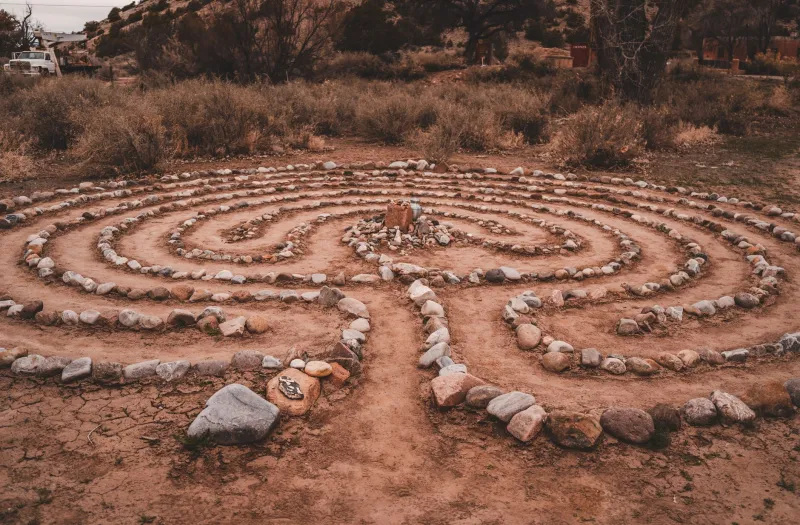
There's a version of Southwest spirituality you've definitely seen advertised. It involves a curated adobe structure, a celebrity shaman with a verified Instagram account, and a price tag that would make your landlord flinch. It's polished. It's photogenic. And according to a growing number of practitioners scattered across Arizona, New Mexico, and the high desert stretches of Southern California, it has almost nothing to do with actual healing.
Meet the other crowd.
The Anti-Retreat Retreat
In a repurposed auto body shop on the outskirts of Tucson, a woman who goes by Soledad runs what she calls a "drop-in healing space" three evenings a week. There are no reservations. No intake forms asking about your dietary restrictions. Folding chairs, a hand-painted altar, and a sliding-scale donation jar — that's the setup. On a given Tuesday, you might find a postal worker getting a sound bath next to a grad student sitting with grief and a retired mechanic who wandered in because the door was open.
"The wellness industry figured out how to sell the aesthetic of healing without actually making it accessible," Soledad says, adjusting a string of lights above a low wooden table. "If you need a credit card to get spiritually well, something went wrong."
This sentiment is showing up all over the region. In Albuquerque, a collective of curanderas and somatic practitioners holds free community sessions in a rented VFW hall twice a month. Outside Sedona — yes, that Sedona — a small group of energy workers has deliberately set up shop away from the crystal corridor, offering work on a pay-what-you-can basis out of a modified Airstream parked on a friend's land. The message, stated or not, is the same: healing isn't a luxury product.
What They're Pushing Back Against
The mainstream wellness industry in the United States is now worth somewhere north of $480 billion, and the Southwest has become one of its most lucrative playgrounds. Sedona alone draws millions of visitors annually for vortex experiences and guided energy sessions. Scottsdale and Santa Fe are lousy with high-end retreat centers marketing "transformation" to people who can afford to fly in for the weekend.
None of that is inherently sinister. But practitioners operating outside that system point to some real costs. Gentrification of spiritual practice, for one — when healing spaces price out the communities they claim to serve, something breaks down. Cultural extraction is another. A lot of what gets sold as "ancient wisdom" in upscale retreat brochures draws heavily from Indigenous and folk traditions that the people selling it have no deep relationship to.
"There's a reason ceremony isn't a product," says Marcus, a Diné practitioner based near Gallup who leads talking circles and traditional sweat lodge ceremonies for community members at no charge. "The moment you put a price on it that only certain people can pay, you've changed what it is."
Unconventional Spaces, Intentional Community
What's striking about this underground healing circuit isn't just the economics — it's the venues. These aren't purpose-built wellness centers with bamboo floors and diffusers running eucalyptus 24/7. They're warehouses. Backyards. Church basements repurposed between Sunday services. A laundromat in Phoenix that hosts breathwork sessions after closing time on Fridays.
The scrappiness is part of the point. When you're not optimizing for the Instagram moment, the space can be genuinely weird and genuinely human. A healing session in a converted storage unit in El Paso, with a box fan doing its best against the heat and someone's kid asleep in the corner, carries a different energy than one in a climate-controlled sanctuary with a curated playlist.
Lupe, who runs a mobile reiki and herbalism practice out of her truck across rural New Mexico, puts it plainly: "People in small towns and working-class neighborhoods need this stuff just as much as anyone. More, maybe. I go to them."
Her route takes her through communities where the nearest conventional healthcare might be an hour away and where the idea of spending a weekend at a resort for spiritual renewal would register as a joke. She charges what people can give. Sometimes that's twenty dollars. Sometimes it's a bag of dried chiles and a handshake.
The Tension Isn't Simple
It would be easy to frame this as pure heroes-versus-villains — scrappy authentic healers versus the soulless wellness machine. But the people doing this work are mostly too thoughtful for that narrative.
Some acknowledge that the commercial retreat world does bring people to spiritual practice who might not find it otherwise. Others note that even sliding-scale models require some income to survive, and that the line between "accessible" and "unsustainable" can get blurry fast. A few have been burned by community spaces that descended into drama, boundary violations, or just the slow entropy of volunteer-run everything.
"This isn't perfect," admits Dara, who helps coordinate the Albuquerque collective. "We're figuring it out as we go. But 'figuring it out as we go' is actually kind of the tradition we're working in."
What the Desert Knows
There's something about the Southwest that keeps producing this kind of experiment. Maybe it's the sheer physical space — room to try things without too much scrutiny. Maybe it's the layered history of the region, where Indigenous practice, Mexican folk medicine, and waves of counterculture migration have been colliding and cross-pollinating for generations. Maybe it's just that the desert has always attracted people who came here specifically because they didn't fit anywhere else.
Whatever the reason, the practitioners in this loose, informal network share a conviction that healing is fundamentally relational — that it happens between people, in community, and that any system which makes it a transaction between a provider and a paying customer has already missed something essential.
The wellness industry isn't going anywhere. The curated adobe retreats will keep filling up, and the influencers will keep posting their vortex selfies. But out in the converted warehouses and desert compounds and laundromats, something else is running parallel — messier, less photogenic, and by most accounts a lot more real.