Sacred Tags: The Southwest Graffiti Writers Who Turned Forgotten Walls Into Altars
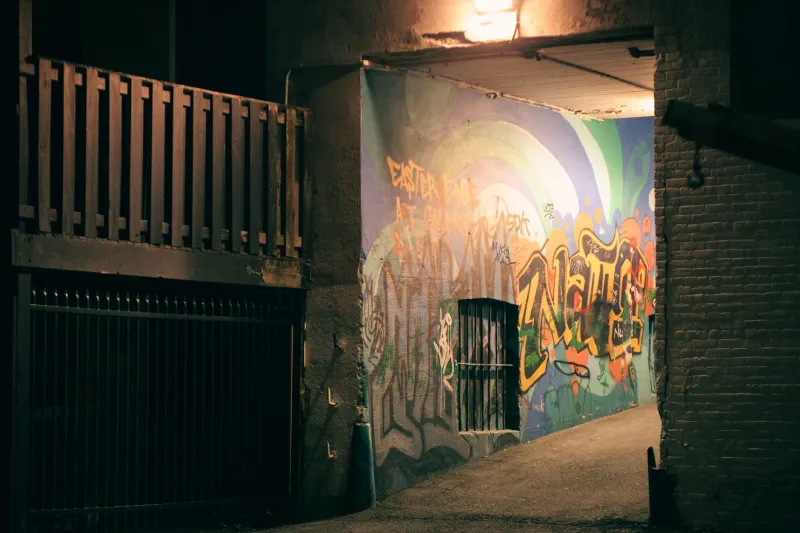
There's a wall on the east side of Albuquerque that most people drive past without a second look. It's tucked behind a drainage canal, half-shaded by a dead cottonwood, and the concrete is the color of old bone. But if you stop — really stop — what's painted there stops you back.
A serpent coils upward through a column of geometric symbols that feel simultaneously ancient and futuristic. Above it, rendered in electric pinks and deep indigos that somehow survive the New Mexico sun, an eye floats inside a sun disc. Around the edges, smaller figures crowd in: hands pressed flat in the style of Ancestral Puebloan rock art, but redrawn with dripping neon outlines. The whole piece hums with intention.
This isn't decoration. The writer who made it — who goes by the name Coyotl and prefers to keep their legal identity out of print — spent three nights on that wall. They brought sage. They brought an offering of cornmeal. They brought seventeen cans of paint and a kind of purpose that's hard to articulate in plain language.
"I don't call it graffiti when I'm working," Coyotl tells us. "I call it marking. The wall already had energy. I was just responding to it."
Where the Spray Can Meets the Spirit World
Across the Southwest — from the industrial margins of Phoenix and Tucson to the older neighborhoods of El Paso and Las Vegas — a loose and largely unorganized movement of graffiti writers is doing something that complicates every easy assumption about what street art is and who it's for. These are artists who move between the visual vocabularies of traditional graffiti culture and something older and harder to categorize: occult symbolism, indigenous iconography, desert mysticism, and a theology of public space that treats the neglected wall as a sacred site.
They don't have a name for themselves as a collective. Some of them barely know each other. But the work rhymes in ways that suggest a shared frequency — a common understanding that the act of painting on a wall the city forgot is, in itself, a spiritual act.
"There's a long history of marking sacred spaces," says Dr. Renata Okonkwo, a cultural geographer at the University of New Mexico who studies urban ritual practice. "What's interesting in the Southwest right now is that you have writers who are consciously plugging into that history. They're not just inspired by petroglyphs or occult diagrams — they're treating the wall as a continuation of those traditions."
The Aesthetics of Resistance
The visual language these writers use is dense and deliberate. Neon color palettes — the electric turquoise, the hot orange, the violent magenta that reads almost violent against adobe and concrete — are a direct inheritance from the region's signage culture. The Southwest has always lit itself up in neon, from the old casino strips of Vegas to the roadside diners of Route 66. These writers have absorbed that glow and turned it inward, using it to illuminate symbols that predate electricity by centuries.
Indigenous imagery appears frequently, though the relationship is complicated and the writers are careful to say so. Several of the artists we spoke with have Native heritage and describe their use of geometric forms and animal figures as a reclamation — a way of pulling ancestral visual language back into the contemporary city. Others, without that lineage, are more circumspect, reaching instead toward broader desert symbolism: scorpions, ravens, the geometry of canyon walls, the specific quality of light that exists nowhere else.
Occult imagery — the kind that's been filtering into Southwest underground culture for years — shows up too. Celestial charts, alchemical symbols, the visual grammar of tarot. A writer in Phoenix named Hex (she paints alone, mostly at night, mostly in the grid of streets south of downtown) describes her practice as "reading the wall before I touch it."
"Every surface has a history," she says. "Concrete absorbs things. I try to figure out what the wall wants before I decide what to give it."
Community in the Margins
What makes this more than a collection of individual practices is the way these writers are quietly building something communal. Not in an organized, grant-funded mural program kind of way — though some of them have navigated that world too — but in the informal, accumulative way that underground movements actually work.
Walls become conversation threads. One writer leaves a piece; another responds to it, months later, on the same block. Symbols recur across cities in ways that feel like a shared language developing in real time. In Tucson, a small crew called Los Espejismos (The Mirages) has been systematically working through a stretch of industrial corridor near the railyards, leaving interconnected pieces that together form something like a narrative — though what the story is, exactly, depends on what you bring to it.
There are gatherings too, though they're not announced publicly. Painting sessions that double as rituals, where the work is done communally and the process matters as much as the product. Someone brings food. Someone brings music. The wall gets painted. The space gets transformed.
"That's the thing people miss when they call it vandalism," says a writer in Las Vegas who uses the name Milagro. "They see the image and they think that's the point. But the point is what happened while we were making it. The point is who was there."
The City as Sacred Ground
There's a political dimension here that the writers don't shy away from. The walls they choose are almost always in neighborhoods that have been systematically underserved — areas where disinvestment is architectural, where the built environment communicates abandonment as clearly as any policy document. Claiming those walls, making them luminous and strange and full of meaning, is a refusal.
"The city decides what gets to be beautiful," Coyotl says. "The city decides what space is worth caring about. We're saying: no. This corner is sacred. This wall is sacred. We're saying it with paint because that's what we have."
Dr. Okonkwo puts it in a broader frame. "What you're seeing is a very old human impulse — the need to mark the places where we live as meaningful, as worthy of attention and care. In the Southwest, where so many communities have had their own marking traditions suppressed or erased, there's extra weight to that impulse. It's not just art. It's an argument about who gets to say what's sacred."
The wall behind the drainage canal in Albuquerque is still there. The city hasn't buffed it. Maybe they haven't noticed it yet, or maybe someone decided to leave it alone. Either way, Coyotl has already started thinking about the next wall — a longer stretch of concrete near a former industrial site, sun-bleached and waiting.
"Every city in the desert has these spaces," they say. "Places the city forgot. We don't forget them. We go back to them. That's the practice."
And somewhere in the gap between what the city sees and what these writers see, something is being built — altar by altar, wall by wall, one charged square of concrete at a time.